


New light on Leonardo Da Vinci’s faces
- How did Leonardo Da Vinci manage to paint such perfect faces?
For the first time a quantitative chemical analysis has been done on seven paintings
from the Louvre Museum (including the Mona Lisa) without extracting any samples.
This shows the composition and thickness of each layer of material laid down by the
painter. The results reveal that, in the case of glazes(1), thin layers of 1 to 2 micrometers
have been applied. The study, led by the team of Philippe Walter, of the “Laboratoire
du Centre de Recherche et de Restauration des Musées de France” (LC2RMF, CNRS/
Ministère de la culture et de la communication), with the collaboration of the European
Synchrotron Radiation Facility (ESRF) and the support of the Louvre Museum,
is published the 15 of July 2010 in the journal Angewandte Chemie International Edition.
Leonardo Da Vinci’s paintings fascinate, partly due to a range of subtle optical effects that blur outlines, soften transitions and blend shadows like smoke. Known as “sfumato”, this technique is not only the result of the genius of the artist but also of technical innovations at the beginning of the 16th century. Minute observations, optical measurements and reconstitutions have already described the sfumato, but new analysis can confirm the procedure of this technique, especially related to how the gradation is done.
For the first time, Philippe Walter (LC2RMF) and his team, in collaboration with the ESRF and the Louvre Museum, have brought new insight on the sfumato thanks to a quantitative chemical study of the different painted layers. Seven paintings of Leonardo Da Vinci have been analysed without extraction, directly in the rooms of the Louvre Museum (Virgin of the Rocks, Mona Lisa, Saint John the Baptist, Annunciation, Bacchus, Belle Ferronnière, Saint Anne, the Virgin and the Child). The scientists concentrated on the study of the faces because they have the characteristics of the sfumato. They used a technique called
X-ray fluorescence(2) to determine the composition and thickness of each layer in nine faces (including Mona Lisa’s) painted by Da Vinci throughout 40 years of career.
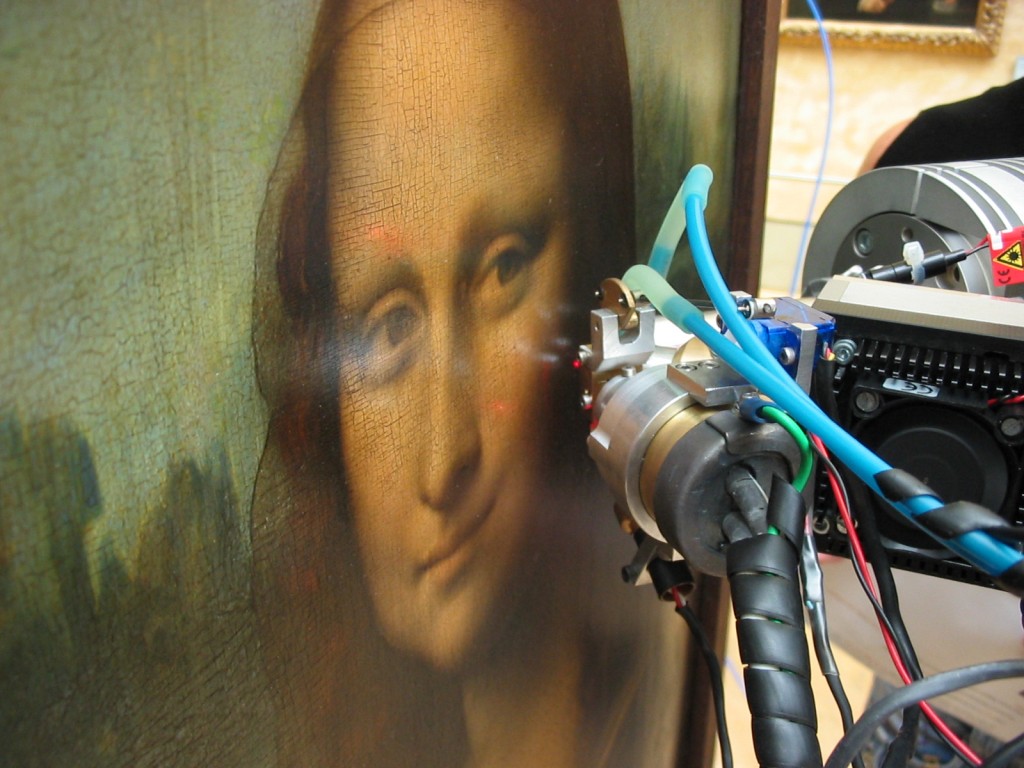
Photo taken during the measurements on the Mona Lisa: X-ray fluorescence spectrometry was done directly on the paintings in the Louvre Museum. © V.A. Solé/ESRF
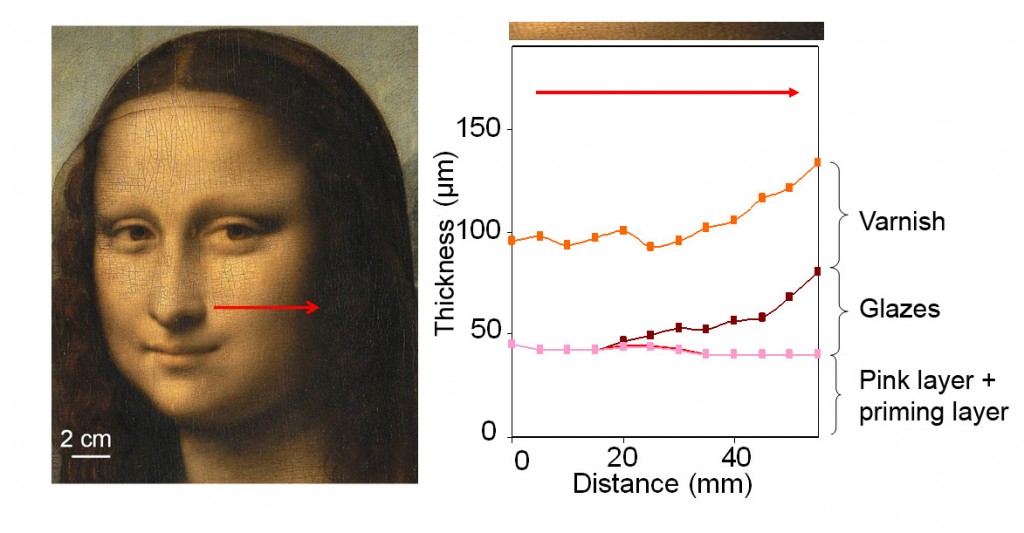
Representation of the superposition of layers in paintings in the face of Mona Lisa, on one light zone near the nose and the darker shadow of the hair. After treating the data, the thickness and concentration of pigments in the different layers. © C2RMF




Hi buddy, your blog’s design is simple and clean and i like it. Your blog posts are superb. Please keep them coming. Greets!!!
Hi! I only wanted to appreciate you for your very captivating post. Posts like this are a extremely brilliant way to help me learn English, but I think I got the story ok Cheers again!
Dear admin, thnx for sharing this blog post. I found it wonderful. Best regards, Victoria…
Great post , but I never was fascinated in the ” Mona Lisa “. Last suffer is amazing
Wow this is a great resource.. Im enjoying it.. good article
This is a great article thanks for partaking this informative information . . I will bring down your web log regularly for some latest post.
The article is very excellent.Let me learn a lot of knowledge.
Thanks for these great tips, love your post, and hope your site continues to grow!
Cool info it is surely. My teacher has been looking for this tips
Ciao, vorrei proporvi http://www.petannunci.com, un nuovo sito di annunci x i nostri amici animali, senza pubblicità o costi di sorta!